Wednesday, 22 August 2012

Go Cheese : From 100% Cow's Milk


GO is the new brand of Cheese from Gowardhan Dairy which is a part of Pune based Parag Milk Foods. Gowardhan Dairy is one of the largest players in the dairy market in India. The company owns India's largest cow farm and also has constructed Asia's largest cheese plant near Pune.

GO cheese brand is the company's venture into the value added product category. The Indian cheese market, although in a nascent market stage ,having a market size of about Rs 2000 crore is dominated by brands like Amul, Britannia, Mother Dairy etc.

GO cheese has entered a market which is growing at around 20% p.a. But the market is dominated by established players on one side while there is a large unorganized market on the other side.
GO Cheese in now running the launch campaign in various channels.
Watch the ad here : Go Cheese

GO cheese is positioned on the basis of the attribute that it is made from 100% cow's milk. The ads are really good and infact I thought GO is an international brand. More than the 100% milk factor, what is more striking about GO cheese is its packaging.

GO cheese has took packaging very seriously and it will be one of the brand elements that is going to help the brand with lot of customer trials. The packaging looks international and the wedge shaped Cheese pack SKU is appealing to kids and will help the brand get lot of customer trials. It is good to see lot of Indian brands utilizing the potential of packaging in their branding efforts.

Besides the smart packaging and interesting communication, GO brand also has a brand mascot - the cow. The mascot ( although the name is not mentioned anywhere) is shown in the pack and reinforces the positioning of 100% cow's milk.

The 100% cow's milk positioning is a good strategy but not new. Infact Amul used the same positioning for its icecream product range. The problem with 100% cow's milk is that competitors can easily copy the USP and hence negate the point of difference created by GO Cheese. If Amul or Britannia starts showing that their cheese is also made from 100 % cow's milk, GO Cheese may lose its USP.

Hence GO Cheese either needs to OWN up this platform or find another USP which could be sustainable over time. GO can only own this positioning through heavy ad spends reinforcing the consumers about their claim. I am not sure whether the brand can spend that much on the promotions . Another way is to create an ingredient brand which can own up the 100 cow's milk proposition . How ever , the brand needs to protect this proposition from the competitors.

There is always a space for new brands in the large untapped Dairy market in India. GO is in the right position to create a space for itself. There are larger issues to consider like the distribution reach and supply chain management. Cheese is a perishable item and needs a very strong supply chain set up if the brand wants to create a national impact.The brand's task will be to get the distribution and logistics correct and ensure enough retail support for the brand. The brand is expected to go on a phased approach while catering to a large market like India. Even Amul is finding it difficult to get its distribution right in many markets. For example, in my city Cochin, Amul dairy product's distribution is erratic with the products not available in many retail outlets. I hope that GO will go after volume only after setting up a strong distribution reach across the markets.

Brand Update : Cadbury Gems changes Target Segment


n a surprising move, Gems decided to re-position itself. The brand so far had appealed to kids suddenly decided to change the target market to  adults. This move is fueled by two campaigns now on air.
Watch the ad here : Gems Sculpture
                               Gems Lady
I am still wondering the logic behind this drastic re-targeting which obviously has to be backed by 
re-positioning. The brand now has the tagline " Raho Umarless" roughly translated to " Be Ageless" .The concept is that the brand encourages the users to enjoy life regardless of the age. Another perspective is that the brand brings the child in you. Although the concept ( although not new) sounds reasonable but the way the agency has executed it is nothing but atrocious. The fact that it is Ogilvy who has done this hopeless work makes it even more surprising. 
From the two ad, the ad featuring the lady is the most atrocious one. Neither the lady looks Child-like nor the hyperbole theme is interesting. The sculpture ad is predictable but still does not convey the brand's intended positioning. 
What is puzzling is the brand's reason for targeting adults. The brand sales may have been plateauing over these years and this may have forced the firm to think about the segments.It is true that Gems is seldom patronized by adults.This is a predominantly kid's chocolate but adults do indulge in it when he buys for the kids.
Some newsreport suggest that Gems has broadened the TG but  the advertisement message suggest that the brand has gone for a complete re-positioning and a change in the targeting strategy rather than broadening. 

While there is a logic behind the new TG, the brand failed to provide any compelling reason for adults to buy Gems. " Raho Umarless" is a weak attempt to attract adult to rethink the way he looks at Gems.Ideally the brand should have attempted a non-hyperbolic, real life enjoyment which would have attracted the TG. The brand is assuming that by looking at a campaign, the adults would indulge. But in my opinion, when repositioning, the brand needs to build salience. So it cannot afford to miss details like Why buy the brand and when to indulge in the brand. Those finer details are missing in the new campaign. 
It is also interesting to see that the brand is not trying to rope in youngsters but adults. Wonder why they chose to target 30 year olds rather than 20 year olds? Remember this is the company that built a brand like Cadbury's Shots in a short period of time. That magic is sadly missing in the ads. It pains when execution fails for a powerful brand like Gems that too when it attempts a repositioning. 

 Having said that the nostalgia of Gems is still there will hopefully drive the brand into adult's mind sans the hopeless repositioning execution. 

Demand for quality warehouses rising rapidly, says report


There is a spurt in demand for logistics and warehousing space in not just key metros but also in leading tier-II cities.
CBRE, the global commercial real estate services firm, in a recent report titledIndia Logistics Market View has found that India witnessed increased market activity in first half of 2012.
e-tailers invested heavily in strategically located assets and have been taking up quality warehousing space across India, primarily in NCR, Mumbai and Bangalore.
However, the availability of large land parcels at relatively low costs, connectivity to multiple markets across States and location of industrial clusters has led to the emergence of some tier-II and tier-III cities as favoured destinations for the development of logistics parks and warehouses.
Rental values witnessed growth across most micromarkets due to the higher demand for warehousing and logistics facilities. The coming months are likely to witness additional supplies across cities, which will positively affect transaction activity in these locations.
Anshuman Magazine, CMD, CBRE, South Asia said, “The rising level of activity in logistics and warehousing space across metros as well as tier-II cities is testimony to the growing confidence of domestic and international retailers in India. Factors such as enhanced connectivity, implementation of various reforms and completion of major infrastructure projects are expected to further augment the logistics sector across India. Going forward, there will be significant reorganisation in the warehousing industry and network planning by organisations in the country.”
FMCG majors, white goods and consumer electronics firms are also on an expansion spree and are steadily increasing their footprint across the country. Built-to-suit options have been the preferred mode of expansion for most occupiers, with large-sized transactions of around 10,000–15,000 sq ft of warehousing space being reported in the first half of 2012.
A large number of domestic developers are moving up the value chain by taking initiatives to provide modern logistics parks with quality warehouse facilities. They are also building assets with better specifications and support infrastructure

Puma’s first ever ‘green’ store to open in Bangalore


Leading sports lifestyle firm Puma is all set to open its first sustainable (read green) standalone store in Bangalore as a part of a global initiative.
“This is Puma’s first such store in the world. We are starting the project with India and depending on its success, will replicate it in other countries,” said Rajiv Mehta, Managing Director, Puma.
He added that Puma’s Indian arm, in 2010, had won the global PPR Innovation and Sustainable Development Award for a project to build an energy-efficient, eco-designed store. After bagging the award, India was chosen as the destination.
The Bangalore store has incorporated several elements of sustainability such as solar PV panels installed on the roof to generate electrical power, an air tunnel for cooling, use of shoe cartons-cum-carry bags and the use of organic cotton for apparels. The surface layout of the store has been designed in a way to ensure optimum use of daylight.
Mehta added that the company would soon be launching its winter collection apparels made of organic cotton. Noting that these initiatives would not only help mitigate costs and risks, he said it would also help grow the business.
Also, material utilised in the store is to be locally sourced and recycled. The company has also partnered with installation artists from the city to create art from using waste material.
Asked whether the company would convert all its existing stores into green stores, Mehta said the company might look at constructing new stores rather than renovating the current ones.
However, without disclosing the number of green stores the company plans to construct going ahead, Mehta said the focus would be on metros and tier-II cities.
“Mall owners in India have started the green initiative a year ago and retailers appear to be following suit. They are doing this from various standpoints. Several retailers are already chalking out plans to go the green way,” said Kumar Rajagopalan, CEO, Retailers’ Association of India.
From charging for carrier bags to installing less harmful refrigeration systems, retailers are improving their green credentials to appeal to environmentally aware consumers, he added.
Meanwhile, mall developers such as Oberoi and Inorbit have also started looking at this aspect and are building malls that are more energy and water efficient.
Globally, wholesale retailers such as Walmart and Tesco are very focussed on energy efficiency such as LED lighting in refrigerated cabinets and zero-carbon store programmes.

Indian paint industry may see slowdown


The Indian paint industry might witness a slowdown both in volume and value growth this year. The volume growth is likely to shrink to 8 per cent (12 per cent), while the value growth is likely to moderate to 15 per cent (22 per cent) in 2012-13.
Estimated at Rs 29,000 crore in 2011-12, the Indian paint industry is likely to be affected by decline in demand and rising cost of production, said, Ramakanth V Akula, president, The Indian Paint Association.
“Although the residential, commercial and retail real estate segments have significant growth potential to spur demand in the decorative paint segment, the Indian retail segment outlook during the year continues to be negative buoyed by persistent sluggish demand due to high inflation, higher construction costs and interest costs among others,” he said at the 49th annual general meeting of Indian Paint Industry here on Wednesday.

Independent directors raise questions listing ONGC Videsh


Independent directors of ONGC are believed to have raised some questions on the proposed move to list ONGC Videsh Ltd (OVL), the company’s overseas investment arm.
Sources close to the development said that besides the timing of the move, the independent directors also wanted to know the intent behind such a decision.
ONGC is debt-free and if funding is the only reason behind the proposal to list OVL, then other mechanisms could also be explored, the independent directors had observed at the recent board meeting of the company.
“The issue has not been put on back-burner, but the company is going to do a detailed study of the questions raised by the independent directors before taking it any further,” an official said.
To fund overseas acquisitions, it was proposed to list OVL to raise approximately Rs 5,000 crore. Another issue that will need to be considered is whether the matter will require Department of Disinvestment approval.
Those tracking the company say that before taking any decision, the sentiments of employees, too, need to be addressed. OVL has always been treated as part of ONGC, drawing internal resources from ONGC.

WEDNESDAY- SENSEX, NIFTY AND RUPEE'S PERFORMANCE


The Nifty and the Sensex closed marginally in the red on Wednesday following global cues.
The Nifty closed at 5413 down eight points while the Sensex ended the day at 17847, down 38 points.
“European indices were down on profit-booking and some caution ahead of the meeting scheduled today between the Greek Prime Minister and Eurogroup Head,” said Nidhi Saraswat of Bonanza Portfolio.
A hike in insurance and pension sector FDI limits to 49 per cent could not prop up sentiment, dealers said.
Volatility was down two per cent and the India Vix closed at 16.Ranbaxy, BPCL, Bank of Baroda, Infy and Dr Reddy were the top five Nifty gainers while Bharti Airtel, IDFC, Sesa Goa, NTPC and Sterlite were the top five losers.
RUPEE:

The rupee closed slightly higher at 55.49 on mild dollar selling by foreign banks and a steady euro. It had closed at 55.57 against the dollar on Tuesday.
The domestic unit, which opened higher at 55.53, was trading range bound between 55.36 and 55.54 a dollar on Wednesday on a stable euro. Euro remained at a near seven-week high after the European Central Bank expressed hopes that it will act on containing Greece’s rising borrowing costs.
The rupee had strengthened to its highest level in more than a week on Tuesday tracking stronger euro and domestic equity markets. It has largely remained range-bound in August over Euro Zone uncertainty.
Call rates and G-secs
The overnight call money rates ended higher at 8.10 per cent from Tuesday’s close of 8 per cent. The call money moved in the range of 7.75 to 8.10 per cent.
The 8.15 per cent government bond maturing in 2022 climbed higher to close at Rs 99.51 (yield: 8.22 per cent) from a close of Rs 99.34 (8.25 per cent) on Tuesday.
The 8.33 per cent bond maturing in 2026 closed higher at Rs 99.56 (yield: 8.38 per cent) from previous close of Rs 99.41 (8.40 per cent) on Tuesday.

Cairn India plans $2 bn capex over two years


Cairn India plans to invest $ 2 billion over the next two years in oil and gas exploration and production both in the country as well as abroad.
“Over the next two years, we envisage a net capital expenditure of $ 2 billion to expand exploration and production of oil and gas in the country and abroad, of which, we plan to invest $ 600 million in Rajasthan exploration alone,” Cairn India Chairman Navin Agarwal told reporters on the sidelines of the company’s sixth annual general meeting (AGM) here.
Cairn, which is currently producing 1,75,000 barrels oil per day from its Rajasthan blocks, expects the potential production of 3,00,000 barrels oil every day.
Based on the revised estimates, the total Rajasthan resource base now supports a potential production of 3,00,000 barrels of oil per day, subject to government approvals and our joint venture partner ONGC and further investment, Agarwal said.
The said production level is equivalent to over 35 per cent of the domestic current crude oil production, which will help reduce the annual import bill by over $ 10 billion and contribute annual revenue of $ 5 billion to the government, he said.
Commenting on its overseas operations, Agarwal said, the company is expanding its international footprint following initial success in Sri Lanka.
The innovative geological studies aided by 3D seismic data led to two discoveries in the frontier Mannar Basin off Sri Lanka. The company has now entered the second phase of exploration and intends to commence drilling in mid-2013.
The company has also successfully acquired a 60 per cent stake from Petro SA in an oil and gas exploration block on the West Coast of South Africa.
Cairn India would be the operator in the block, while PetroSA, owned by the government of that country, would hold the remaining interest, Cairn India outgoing managing and chief executive Rahul Dhir said.

Cairn India plans $2 bn capex over two years


Cairn India plans to invest $ 2 billion over the next two years in oil and gas exploration and production both in the country as well as abroad.
“Over the next two years, we envisage a net capital expenditure of $ 2 billion to expand exploration and production of oil and gas in the country and abroad, of which, we plan to invest $ 600 million in Rajasthan exploration alone,” Cairn India Chairman Navin Agarwal told reporters on the sidelines of the company’s sixth annual general meeting (AGM) here.
Cairn, which is currently producing 1,75,000 barrels oil per day from its Rajasthan blocks, expects the potential production of 3,00,000 barrels oil every day.
Based on the revised estimates, the total Rajasthan resource base now supports a potential production of 3,00,000 barrels of oil per day, subject to government approvals and our joint venture partner ONGC and further investment, Agarwal said.
The said production level is equivalent to over 35 per cent of the domestic current crude oil production, which will help reduce the annual import bill by over $ 10 billion and contribute annual revenue of $ 5 billion to the government, he said.
Commenting on its overseas operations, Agarwal said, the company is expanding its international footprint following initial success in Sri Lanka.
The innovative geological studies aided by 3D seismic data led to two discoveries in the frontier Mannar Basin off Sri Lanka. The company has now entered the second phase of exploration and intends to commence drilling in mid-2013.
The company has also successfully acquired a 60 per cent stake from Petro SA in an oil and gas exploration block on the West Coast of South Africa.
Cairn India would be the operator in the block, while PetroSA, owned by the government of that country, would hold the remaining interest, Cairn India outgoing managing and chief executive Rahul Dhir said.

India is world leader in concentrated solar heating, says Ministry


With some 80 different applications of concentrated solar heating in practice in the country, India is the world leader in CSH, the Ministry of New and Renewable Energy has said.
When you speak of solar energy, you think mainly of solar panels and electricity flowing from them. Then you would think of appliances such as solar water heaters and solar lamps.
But the big use of solar energy lies in directly using the sun’s heat for use in industry. Lots of manufacturing units require just low-to-medium temperature heat, up to 250 degrees Celsius, mostly for drying stuff. Today, this heating is done by burning fuel oil, coal or biomass.
Here is where India scores, both in terms of potential and also applications developed, says the Ministry.
“India is leading the world with around 80 CSH applications,” it has said in a background note to UNDP-GEF sponsored project for nurturing CSH technologies in India.
Without going into details of the 80 applications, the Ministry has noted that the predominant use of concentrated solar heating is in “institutional cooking”.
In India, the current CSH market is about 2,000-3,000 square metres a year (of the concentrated area), says MNRE. The Global Environment Fund project will complement MNRE’s efforts of CSH technology, awareness, capacity, market and financial barriers and increase CSH sales to 15,000 square metres by 2016.
Direct emission reductions from the demonstration and replication projects during the 5-year project duration will be 39,200 tonnes of carbon-dioxide equivalent.
Over the economic lifetime of 20 years for the project supported CSH applications, cumulative direct emission reductions will be 315,000 tonnes of CO2, the Ministry says.

Tuesday, 21 August 2012

NDTV Good Times : A Unique Co- branding

In September 2007, NDTV launched India's first hardcore lifestyle channel branded NDTV Good Times. This new channel is unique in two ways - its India's first lifestyle channel and secondly its the first time where a product brand has co-branded with a channel.
Co-Branding is where two brands operating in two different domains coming together for a common cause ( objective) . The objective can be anything from tapping a common market or sharing promotions. The oft quoted examples in classrooms were the co-branded credit cards .
NDTV Good Times is promoted by NDTV alone and not with any equity stake by the UB Group.
The new channel is all about lifestyle. In theory , we tend to describe lifestyle with the three descriptors
Activities
Interests &
Opinions ( AIO).
Truly like this concept, Good Times is all about activities, opinions and interests. The channel devotes its time to Health, Fashion, Food, Luxury, Technology , Chats with celebrities, life of rich and the famous etc. The channel also wants to create a class of its own by roping in HOT Properties to anchor respective shows. These include the actor Rajat Kapoor, Chef Manju Malhi, Techie Rajiv Makhni etc. The channel is full of aspirational lifestyle programs and contains about 50-60 original programs per week.
The channel is looking at the target market comprising of socially upbeat 20-40 yr old SEC A viewers.
The questions arises as to the benefit of these two different brands coming together in a channel. For NDTV, the brand association with Kingfisher gives it the revenue cushion. According to Agencyfaqs, UB group has committed around Rs 100 crore worth of ads in the next five years. For NDTV this takes away the risk of launching a lifestyle channel with is atmost a Niche . Kingfisher will provide the much needed ad revenue till the channel began to attract other advertisers.

For UB Group, its a boon. We know that Indian law does not permit Kingfisher Beer to advertise. The rules are getting stricter day by day. Hence there is nothing better than a channel that carries your tagline and the mascot. Besides that every businessman knows the power of having a media under its fold. UB Group may not have the capability to run a media, so why not associate with the best brand in the media domain NDTV. Also Kingfisher as a brand epitomizes lifestyle positioning. Whether its the beer or the airlines, Mallya has built the brand on lifestyle platform . Hence Co-branding with a lifestyle channel makes perfect sense.

But things are not as rosy as it seems. This whole concept will work only if NDTV can bring in quality content to the channel. NDTV has proved its capability in the news front but entertainment is a different ballgame altogether. Right now cost of the new launch maynot be a headache since NDTV has its processes and systems in place. What is going to make or break this channel is the quality of programming and the innovation that this channel will bring in to get the eyeballs sticking. For NDTV , Good Times is testing waters since it plans to roll out an entertainment channel in collaboration with the ace director Karan Johar. For Kingfisher, its a promotional expenditure ( nobody ever has perfectly measured the effectiveness of advertising as yet !!!). I feel that Good Times channel will be an integral part of inflight entertainment in the airlines too in future.
So as of now its a win-win game for both the brands. Time will tell if GOOD TIMES will last.
Related Brand
SOURCE: MARKETING PRACTISE.COM

Colour television sets will sell till Bharat exists


With the advent of panel televisions, the colour television (CTV) business seems to be dwindling. However, on a closer look, there is a thriving market for CTVs.
Leading players say that un-penetrated semi-urban and rural markets are still buying CTVs. LG claims that 40 per cent of their total television sales come from this segment.
S. H. Park, Director-Home Entertainment, LG India, says, “Penetration of television is still low in India, especially in semi-urban and rural areas. These are the areas that are driving the demand for television sets. Since a large proportion of customers are price sensitive, the CTV still has strong demand in such areas.”
Mahesh Krishnan, Vice-President, Samsung India, also claims that 50 per cent of their total television sales come from CTV sets. Although the market for panel televisions (LED/LCD TVs) is also growing, with smaller panels available at competitive prices, he adds.
Videocon, too, says that 18 per cent of their sales turnover comes from CTVs. “Our main market for this segment is outside the top 20 towns. There are enough people in this country buying their first television,” says H. S. Bhatia, Chief Marketing Officer, Videocon.
“Although there is a decline in industry growth of almost 10-11 per cent every year, we will not be phasing out CTVs. We will let the market forces decide on the phasing out date,” he adds.
Videocon is the largest manufacturer of colour televisions in India and exports to West Asia, Indian sub-continent and North and Central African countries. “We have a home entertainment television series that works on the limitations of an LCD. It allows for loud sound, unlike an LCD, and also has USB port. We are bringing in little innovations to keep the otherwise stagnant market floating,” Bhatia adds.
While many dealers in big cities have phased out CTVs, South Delhi-based Murthy Electronics claims that as much as 40 per cent of their sales come from this segment. Intex, LG and Samsung are the three brands that it sells, Samsung being the best selling one.
Sargam Electronics, a South Delhi dealer of white goods, also continues to sell CTVs. “Although we keep only two-three sets for display, almost 5-7 per cent of our sales come from colour televisions.” Priced in the range of Rs 5,000 to Rs 13,600, this dealer sells Samsung CTVs all over Delhi.
“For every 10 LCDs, we sell two CTVs,” says another Delhi based dealer.

New standard packaging norms for FMCG cos from Nov: Govt


Amid growing cases of unfair trade practices, the government today said it has made it mandatory for FMCG companies to pack and sell specific products like biscuits and milk powder in standard sizes only with effect from November 1.
Following complaints regarding unfair reduction in the quantity of packaged products from some consumer organisation, the government has amended the Legal Metrology (Packaged Commodities) Rules 2011.
“It has been observed that some manufacturers in the country are reducing quantity of packaged products by small fractions without making a change in the price of the product.
The government after due examination of the issue amended the Legal Metrology Rules, 2011,” Food and Consumer Affairs Minister K V Thomas said in a written reply to the Lok Sabha.
As per the amendment, all manufacturers of 19 commodities mentioned in second schedule of the said Rule will have to mandatorily pack items in standard sizes only, he said, adding that any unfair reduction of quantity will not be permitted.
This order will be implemented from November 1, 2012, he said.
Baby food, weaning food, biscuits, bread, butter, coffee, tea, cereals, pulses, milk powder, salt, edible oils, rice and wheat flour, aerated soft drink, drinking water, cement and paints are among other products that manufacturers are required to pack and sell in standard sizes, he added.

Referral schemes make inroads into logistics sector


Referral schemes have started catching up in the domestic logistics sector, albeit discreetly.
The scheme, which exists only “informally in India”, entails providing commission to existing customers for referring new customers — a practice prevalent in developed countries.
DHL, for instance, had last year launched a “referral scheme” for its customers in the US. The scheme, launched for small and medium businesses, offered discounts in transportation charges to its existing customers in the segment for providing referrals.
“The discount levels varied, based on the value of business offered to DHL from the new customers,” a company official told Business Line.
Now, similar practices are catching up in India, though many logistics players are unwilling to share details.
“We do not have such referral schemes though they do exist informally,” says Vineet Agarwal, Joint Managing Director, Transport Corporation of India. Safexpress’ Vineet Kanaujia, Vice-President-Marketing, says while his company gets queries based on referrals by corporate clients, there is no “organised scheme per se that provides discounts to existing customers.” Blue Dart, in which DHL has a majority stake, refused to comment.
Volume discount is the prevalent form of incentive in the logistics sector. For instance, Container Corporation of India provides total volume discounts of over Rs 30 crore annually to its customers who commit incremental cargo of certain levels.
“As of now, we are not aware of any commission being offered for providing referrals, but as the logistics players themselves are working towards a cost-effective model, this may become a norm for the industry,” says Kashyap Deorah, President, Futurebazar.com, the online platform of Future Group.
Subrata Dutta, Managing Director, Samsonite India, says despite logistics costs being a significant 7-8 per cent of the total cost, the company is not aware of any such commissions being provided by its logistics service providers. He, however, added that he would discuss this strategy with his logistics service provider.

Broker-friendly portal is new mantra for bourses


Competition has spurred stock exchanges to enhance the user-friendliness of their member portals.
A member portal provides a Web-enabled interface between the trading members and the exchange to facilitate certain day-to-day operations including billing, compliances, submission of applications, clearing and settlement and collateral management among other features. The aim being to steadily graduate to paperless transactions, optimise response time for the exchange by saving man hours whilst providing flexibility and convenience to members.
However, instead of outsourcing its development to technology partners, exchanges are opting to develop the same in-house and tweak it according to the feedback received from their members.

SIGN-ON ACCESS

The NSE, for instance, recently come out with several self-help features for its customer service portal and issued letters to its individual broker members informing them of the same and seeking their feedback.
The new features include a single sign-on access provided with an administrator login which has rights to create, modify, delete user ids and assign roles, the facility to directly handle all password reset requests without having to request it from the exchange.
Brokers registered with the NSE would now also be able to take advantage of “NSE Assist” which has been integrated with its member portal. Launched in September 2011, NSE Assist is an additional channel of communication between members and the exchange that enables members to login their queries, monitor its progress and also allows members to give their feedback on quality and speed of resolution.
Furthermore information such as billing download summary, margins and collateral summary and alerts on dates for various compliance submissions to create a reminder mechanism would now be available to the members with a click.
Head of Business Development, NSE, Ravi Varanasi said: “The idea was to integrate all customer service features under one umbrella for the convenience of the brokers.”
Similarly the BSE, which caters to its 1,500-strong members, boasts of providing features such as electronic filing system, unique client code, electronic contract notes, extranet, real time risk management system, collateral module and LEIPS (Liquidity Enhancement Incentives Programme) on its member portal.

MCX-SX FOLLOWS SUIT

The latest entrant on the equity exchange block, MCX-SX too is in the process of fine-tuning its present member portal called ‘My Exchange’ for the benefit of its existing 751 members and also gearing up to cope with its upcoming equity platform launch.
MCX spokesperson said: “We launched ‘My Exchange’ a couple of months back. We will continue to review feedback and add more features to this interface for greater convenience of our members.”
As of now ‘My Exchange’ which was launched on May 24 facilitates submission of online application for registration of Authorised Persons, access information relating to margins, obligations and collaterals and placement of request for release of collaterals.

Why the petrol price hike is a good thing?


Petrol prices are about to be raised again  and the hike leaves the country seething, except those that drive diesel cars. And to make the diesel owners wince a little, the government will decide the fate of that fuel too, in a meeting soon. While there is outrage about this "unprecedented" price hike, let me play devil's advocate and temper down some of the most vehement arguments against this increase.
Petrol Prices
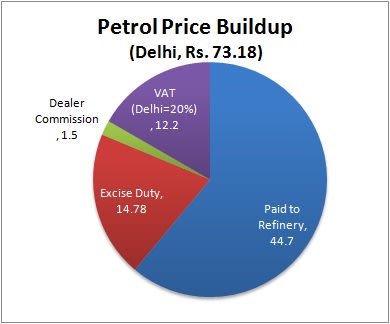
With a tax of Rs. 26 per litre, can they not reduce taxes? Goa, for instance, has cut state taxes to zero; this gives the Goan petrol pump the ability to sell petrol at Rs. 61, a good Rs. 12 less than the Delhi price of Rs. 73. How, though did the brand new Chief Minister, Mr. Manohar Parrikar do it?
He replaced the lost revenue on petrol by increasing taxes and fees everywhere else. After the monsoon session, you will have pay a toll tax just to enter Goa. Alcohol will be more expensive. A power of attorney that used to cost Rs. 25 will now cost Rs. 500. A 10% luxury tax now applies to beauty parlours. Cars get more expensive with entry taxes, VAT increases and higher road taxes.
So do you really want that, fellow Indians? That the government cuts taxes on petrol and diesel, and instead makes it more expensive for you to do anything else? Goa made the grade, and has not yet seen the impact — of lower consumption due to the higher taxes. Other states, which are more dependent on the fuel revenue than Goa, might not be able to comply. Regardless, it is highly unlikely that we'll stay wedded to a low petrol price if it means higher taxes and prices elsewhere.
State VAT is only one part of the tax problem — a larger chunk is the centre's "excise duty" which adds Rs. 14.78 to the petrol price, and which if brought down could make life a little easier for those of us that travel in petrol vehicles. So why can't the states and centre cut taxes together?
The central government isn't earning much more than it did, and if you take away some tax revenue, the gap between income and expenditure — a wide one already — will widen further.
The second argument then is: the government needs to spend less. That it does. It spends a lot of money just paying the oil companies for their taking losses on diesel and kerosene. In effect, a portion of what it collects as tax on that fuel goes back into paying for the losses incurred on these fuels. Yes, the government could cancel them out — reducing the subsidy while at the same time cutting taxes on diesel. But that won't touch the petrol price — which isn't subsidized, and the losses due to a cut in taxes won't be nullified in any other way.
Why can't the government cut taxes anyhow? Cutting government revenues is a problem of optics. Imagine being told that you must take a cut in salary, because the government just cut your income tax rate by 20% and inflation is only 10%. This is not acceptable to most people, although they might universally agree that a tax cut puts more in their pocket than earlier. A drop in revenue, for the government, is unthinkable, even if they did manage to cut expenses.
And there's the political problem of austerity. Spending lesser means cutting government employee salaries, cutting farmer subsidies like fertilizers, reducing the wages paid in the NREGA scheme or otherwise spending lesser on infrastructure. All these solutions have political problems, and the government will do all it can to prevent a backlash in these high-voter areas; petrol users are simply those that have enough money to avoid public transport, but not enough to buy a diesel guzzler, a population that is, by and large, not inclined to vote either. Most unrelated expense items have been cut already, even as the fiscal deficit — a measure of how much more the government needs to borrow to match expenses with revenues — ended up over 5% of GDP.
Prices also give a signal. If you raise prices, you lower demand. And undoubtedly, we need to reduce our reliance on petrol and diesel, which come from crude oil, our largest import. We import around $150 billion worth of crude oil every year, a figure that only increases as crude oil reaches new heights. This increases our trade deficit, and reduces the value of the rupee in dollar terms, which, in the end, makes our petrol more expensive in rupees. Our consumption hasn't slowed, mainly because we prefer, as a country, to not pass on market prices to our consumers. Effectively, without a price signal, consumption patterns don't change. Freeing prices may make them volatile, but we have lived with volatile necessities for years — no one, for instance, calls for potato prices to be regulated. Even the search for alternative fuels or the encouraging of cheaper ones like natural gas will not happen as long as prices for current fuels remain subsidized.
On that vein, diesel prices must be increased as well, and LPG. The oil companies lost nearly 140,000 crores (Rs. 1.4 trillion) in diesel, LPG and Kerosene last year, half of which the government must bear.
Petrol prices may come down anyhow. The calculations above reflect a crude price of $124 in April, which has since fallen to $105 recently, even as the rupee touches Rs. 56 versus Rs. 53 earlier. Net of the above, petrol prices can fall to nearly Rs. 64 per litre, without any changes in state or central taxes. But that shouldn't change the view that prices need to stay deregulated. After all, when international prices go down, we won't like the argument that they can't cut prices until they make up for past losses.

Sensex gains 194 points OUR BUREAU


Global risk off sentiment and expectation of policy action by the Centre saw the Nifty and the Sensex rise in excess of one per cent on Tuesday.
The Nifty closed at 5421, up 55 points (1.02 per cent). The Sensex was up 194 points (1.1 per cent) and closed at 17885.
“Markets were up marginally on the back of continuing expectations of initiation of fiscal reforms. The progress of monsoon also boosted the sentiment a bit. IT stocks were up. Infosys stock closed higher as the US court ruled in favour of Infy in an employee harassment case. Also, the stability in the US and Europe supported the IT stocks,” said Mr. Dipen Shah, Head-PCG Research Kotak Securities.
Volatility was high and the India Vix closed at 16.30 up 3.62 per cent. Sterlite, DLF, Sesa Goa, NTPC and Ambuja Cement were the top five Nifty gainers while Bharti Airtel, Cairn, PNB, Hindalco and Tata Steel were the top five losers.

Tata Steel to redeem dollar bonds


Tata Steel will redeem all its convertible alternative reference securities (CARS) at a premium of 123 per cent by September 5. This will result in an outgo of Rs 2,602 crore.
Tata Steel is paying off its liability due under CARS to the extent of $471 million for the principal amount, along with accrued interest of $1.9 million for the last six months on the maturity date (September 5), the company said in a statement.
In 2007, Tata Steel, in a bid to part-finance the Corus acquisition, raised $875 million through issue of CARS which matured in 2009. The company came up with an exchange offer for CARS holders in 2009.
According to the offer, the investors had the option of switching over new foreign currency convertible bonds (FCCBs) maturing in November 2014 or stick with the CARS that was slated for repayment on September 5. This arrangement was made to lengthen the debt maturity profile, reduce the cost of issuer and potentially trim future repayment obligations, Tata Steel had said.
Shares of the company on the BSE were down one per cent at Rs 392 on Tuesday.

Reliance Infra targets Rs 20,000 cr from road projects


Reliance Infrastructure sets great store by road projects. The company is today building eleven road segments with a total length of 968 km, costing Rs 11,700 crore.
“The company is targeting to build road business up to Rs 20,000 crore by the end of this financial year,” says the company’s Web site.
The optimism arises out of the fact that the National Highways Authority of India is coming out with 10 mega highway projects and major six-laning projects.
Out of the 11 road projects, six are in Tamil Nadu.
Two of the eleven projects (Namakkal-Karur, 43 km and Dindugul-Salem, 53 km, both in Tamil Nadu) started earning revenues in 2009. Two more (Salem-Ulundurpet, 136 km, Tamil Nadu, and Gurgaon-Faridabad, 66 km, Haryana) went on stream recently.
Thus, most of the road projects already on hand are seasoning for revenue flows. “Reliance Infrastructure expects three more roads to be revenue operational in the current financial year, and one more next year,” says an analytical report of Edelweiss Securities.
According to information provided in Reliance Infrastructure’s Web site, it is not as though some of the projects have to be completed for them to earn revenue.
Among the projects awarded and which the company is getting ready to execute, three are for six-laning the four-lane roads.
“In these six-laning projects, tolling can be commenced parallel to the commencement of construction from the day financial closure is achieved,” says the company’s Web site.
One of the three is the 60 km Hosur-Krishnagiri project, also in Tamil Nadu. The other two are Delhi-Agra, 180 km, Haryana-Uttar Pradesh, and Pune-Satara, 140 km, Maharashtra.
Reliance Infrastructure, a part of the Anil Dhirubhai Ambani Group, is also into providing engineering, procurement and construction services for power generation, transmission and distribution projects.
It also holds 38 per cent in Reliance Power, which has plans to build 32,000 MW of generation assets. Further, Reliance Infrastructure, through special purpose vehicles, operates the Metros in Delhi and Mumbai.
In the first quarter of the current year, Reliance Infrastructure reported a net profit of Rs 327 crore, which was 24 per cent lower than in the corresponding period of last year (Rs 430 crore).

Tata Tea has ‘Grand’ designs on Russia


In a bid to expand its global tea and coffee business, Tata Global Beverages has acquired SuntyCo Holding, the owner of the ‘Grand’ tea and coffee business in Russia, for an undisclosed amount.
Tata Global Beverages and the European Bank of Reconstruction and Development, which together held 51 per cent of SuntyCo Holdings, have acquired the remaining 49 per cent of shares.
In 2009, the beverage giant, then Tata Tea, had acquired 51 per cent in the Russian company, along with the European Bank for Reconstruction and Development. Tea is Russia’s national drink and an average Russian consumes 1.2 kg a year, compared to the global average of 0.3 kg. The hot beverage has a rich and varied history.
It was introduced in the USSR in the 16th century by the Chinese, but when ties with China turned sour in the 1970s, the USSR started importing tea from Ceylon and India. Soon, Indian tea conquered the Russian palate. With this acquisition, Tata Global Beverages’ presence in the Russian hot beverages market is to be further strengthened.
“This is in line with Tata Global Beverages’ strategy to invest in and grow beverage brands in identified key markets, through both acquisition and organic growth,” said a company spokesperson.